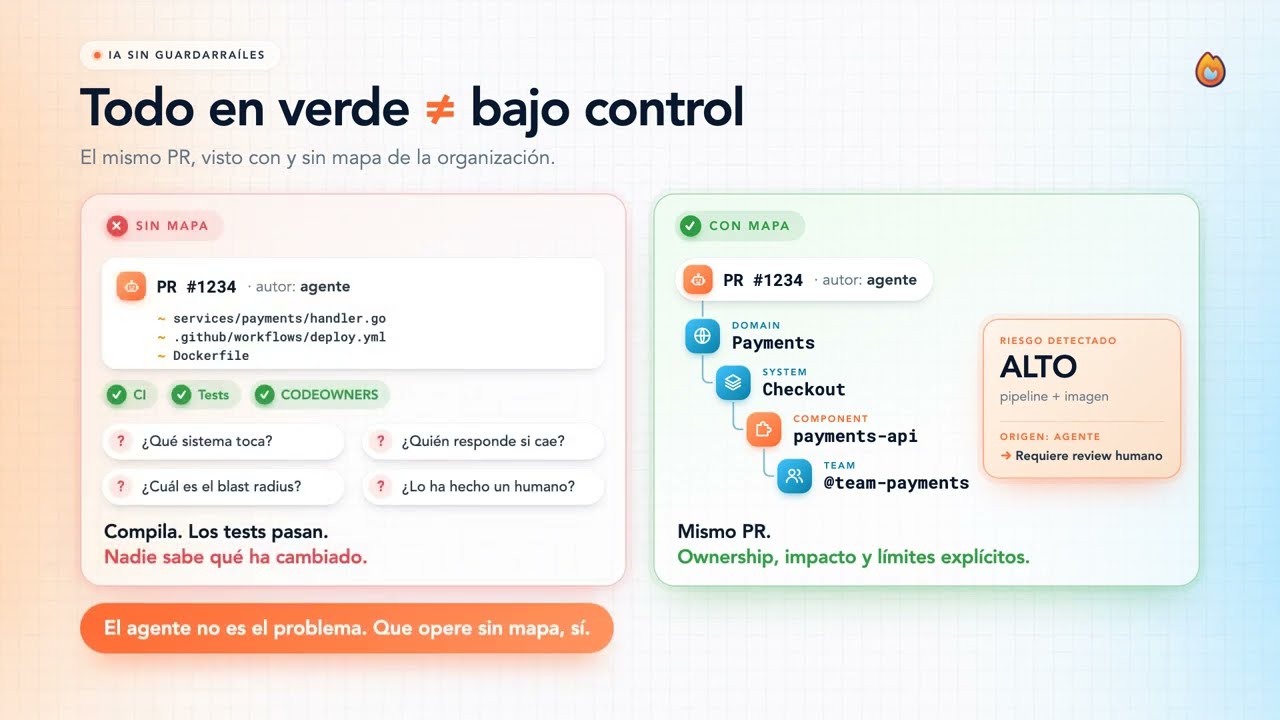
An agent can change a microservice, a pipeline and a Dockerfile in one pull request. Compiling and passing tests show that a change is technically coherent; they do not prove that it respects ownership, system boundaries or its potential impact.
Speed does not solve control
The practices established with DevOps still matter when agents generate some of the code. The volume of changes may grow, but the team remains responsible for them.
Five practices that still matter
| Practice | What it contributes to agent-generated changes |
|---|---|
| CODEOWNERS and branch protection | Keep responsibility and review ownership clear. |
| Linters and static analysis | Catch broken conventions and obvious side effects. |
| Tests and CI | Check that a change does not break known behaviour. |
| Reproducible images and pipelines | Prevent deployment changes from advancing without validation. |
| Human review | Adds intent, domain context and the team’s tacit knowledge. |
Context is the boundary
Tests can pass while a change crosses ownership boundaries or expands the blast radius too far. Agents need explicit limits and validation that makes those limits visible as they work.
Human review remains important for deciding whether a solution makes sense in the context of the business and the system.
Automate responsibly
The goal is not to slow agents down, but to give them a safe path: reviewable changes, clear ownership and checks that run before integration. Then generation speed can become sustainable progress instead of immediate technical debt.